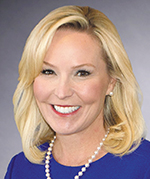
Laura Williams, MD, FACS, FACOG
Sometimes less is more. As a resident, Laura Williams found she particularly enjoyed caring for women with gynecologic malignancies. “I much preferred taking care of a fewer number of women with complex medical and surgical issues,” she said. Williams’ interest was spurred by Howard Homesley, MD, who was Division Director of Gynecologic Oncology at Wake Forest University School of Medicine. “He was a tireless surgeon and clinician who was willing to tackle the toughest clinical situations,” she recalled. “He helped me obtain a prestigious fellowship position at Memorial Sloan-Kettering Cancer Center in New York City.” When Williams was training in the 1980s, fewer than 10 percent of those specializing in gynecologic oncology were women. “It was really attractive to be a woman caring for women. Amongst my co-residents, I was one of few females.” Although more women are entering the field today, there is still a need for specialists … of both genders. “Approximately 35 gynecologic oncologists a year are board certified,” noted Williams. “That’s less than one per state.” The clinical knowledge driving the field, however, is exploding. Williams said new information becomes available on an almost daily basis so she voluntarily opts to recertify annually to keep current. Williams has also been active in improving surgical options to minimize side effects, including working with Intuitive Surgical on advancing minimally invasive robotic techniques. “One of the many things I love about my career is being able to solve difficult problems with the least amount of hardship for the patient,” Williams said, noting that many of the women referred to her have complicated pelvic tumors. “After 24 years of experience in training and in practice, I am able to remove or reduce these tumors with minimal complications such as blood loss or injury to vital pelvic structures. For other patients who are candidates for daVinci® Robotic Surgery, I can remove pelvic organs and lymph nodes through tiny incisions, which allow the patient to go home the day after surgery and return to work in less than two weeks.” Although clearly passionate about her field, Williams has always recognized the importance of maintaining a life balance. As an undergraduate, she spent a year abroad at the Free University of Berlin. “I knew that I was going to medical school so I wanted a good, broad-based liberal arts education,” she explained. Today, balance comes from spending time with her husband, Mark Walker, and their children. Walker is CEO of the not-for-profit Excel Aquatics, which has trained athletes to swim competitively for more than two decades. Williams serves as the organization’s webmaster and her two sons swim year-round with the program. “It’s a family affair,” she laughed. Williams also enjoys trying out interesting, new recipes. That works out well since on any given day she has three teenage boys to feed. In addition to her sons Michael and Nicholas, Williams’ stepson Michael Walker plays baseball for Father Ryan, and her stepdaughter, Erin Walker Howington, is a critical care nurse at Saint Thomas Hospital. Just as teamwork and collaboration keep her personal life in sync, Williams believes those same lessons apply to the clinical setting. “I would encourage healthcare providers to continue to reach beyond their comfort zone for therapies and techniques that may help their patients in new and innovative ways,” she said. “Whether that may be … for example … minimally invasive surgical techniques or novel biologic anti-tumor therapies, there will be colleagues in your field with an interest in these modalities who can help and encourage you to provide the best care available.”
Tags:None
|